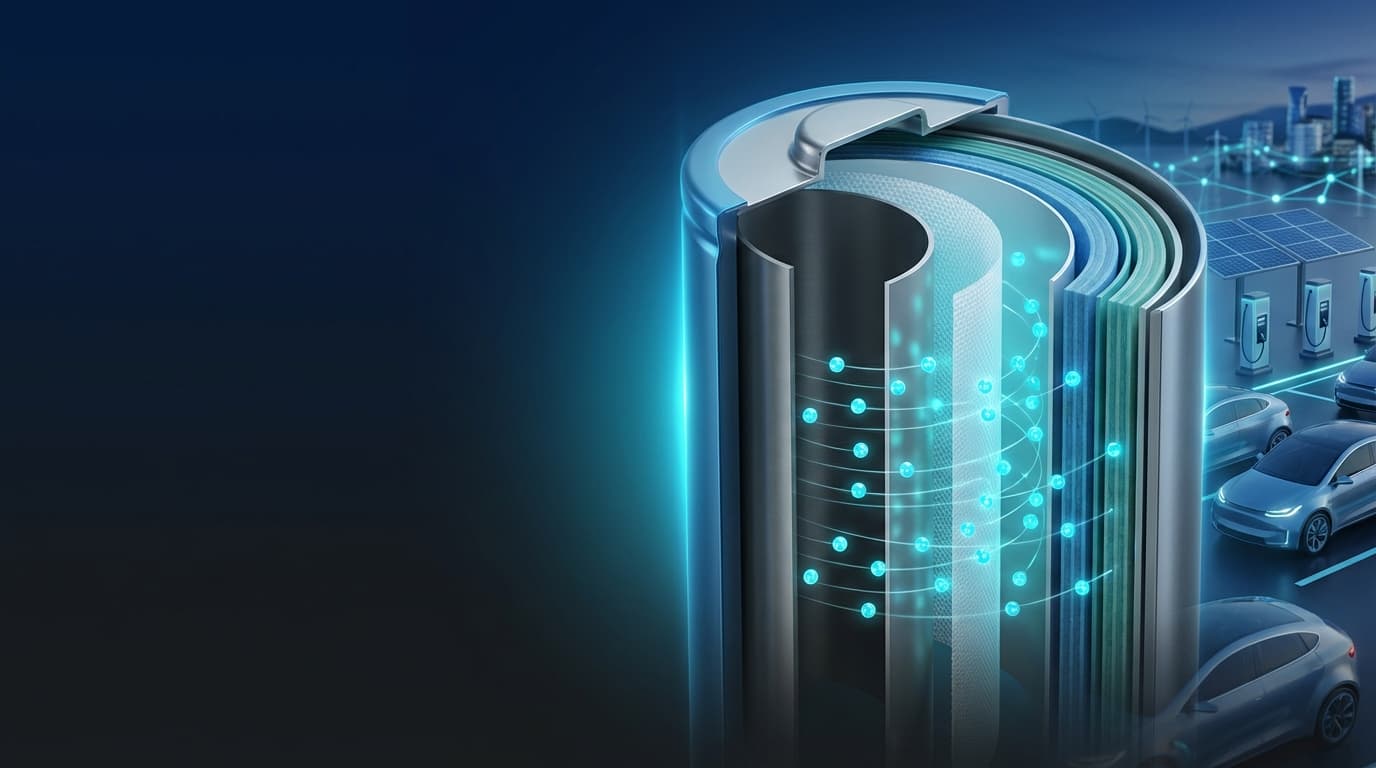
Batteries are among the most complex electrochemical systems deployed at scale today. They power vehicles, fleets, depots, grids, ports, and cities. Yet despite their central role in electrification, batteries are often simplified to capacity, range, or charging speed. In reality, performance, durability, and safety are determined by what happens inside the cell, at material and electrochemical level. Understanding this complexity is not optional, it is foundational.
From Pack to Cell: Where Energy Is Actually Stored
A lithium-ion battery system is structured in layers:
Battery pack – the complete system installed in a vehicle or application
Modules – groups of connected cells
Cells – where electrochemical energy storage actually occurs
The “magic” of energy storage happens at cell level. Each cell is an electrochemical system consisting of:
An anode
A cathode
A separator
An electrolyte
Lithium ions move between anode and cathode during charge and discharge. Electrons travel through the external circuit, delivering usable electrical energy. The stability, durability, and risk profile of the battery are defined here.
The Three Dominant Cell Formats
Today’s lithium-ion batteries primarily use three cell formats:
1. Cylindrical Cells
Cylindrical cells are built with a rigid metallic outer shell. The electrodes and separator are wound into a spiral configuration.
Advantages:
High energy density
Cost-efficient production
Mature manufacturing processes
Challenges:
Complex cooling architecture
Monitoring and assembly complexity
They are widely used in high-volume automotive applications.
2. Prismatic Cells
Prismatic cells use a rectangular metallic housing. Electrodes are stacked in layers rather than wound.
Advantages:
Efficient space utilization
Good thermal conductivity
Simplified module integration
Challenges:
More complex design and manufacturing
Higher cost structure
This format is often selected for structured pack integration.
3. Pouch Cells
Pouch cells enclose active materials in a flexible laminated foil.
Advantages:
Flexible sizing
Good thermal performance
High design adaptability
Challenges:
Mechanical vulnerability
Requires external compression in modules
Pouch cells offer packaging flexibility but require careful mechanical design.
The Electrochemical Process Inside the Cell
The fundamental principle of a lithium-ion battery is the galvanic cell.
During discharge:
Lithium ions move from the anode through the electrolyte and separator to the cathode.
Electrons move through the external circuit, performing electrical work.
During charging, the process reverses. The separator prevents electrical short circuits while allowing lithium-ion flow. The electrolyte enables ion transport. While this sounds stable and controlled, the reality is dynamic. Material expansion, degradation, resistance changes, and thermal gradients continuously influence cell behavior. This is where performance and safety intersect.
Materials Define Performance and Risk
Lithium-ion batteries are highly versatile because different cathode and anode materials can be combined to optimize energy density, cost, durability, or stability.
Cathode Materials
Common cathode chemistries include:
LCO (Lithium Cobalt Oxide)
High energy density but limited thermal stability.NMC (Nickel Manganese Cobalt Oxide)
Balanced performance, energy density, and cost.NCA (Nickel Cobalt Aluminum Oxide)
High energy density and durability, with cost and safety trade-offs.LFP (Lithium Iron Phosphate)
Strong thermal and chemical stability, long lifetime, lower energy density.
Each chemistry represents a trade-off between energy, lifetime, cost, and thermal behavior.
Anode Materials
Most lithium-ion batteries use:
Graphite
Stable, cost-efficient, widely adopted.
Alternative materials include:
Lithium Titanate (LTO)
Excellent safety and lifetime characteristics, lower energy density.Lithium Metal
Very high energy density, significant stability challenges.
Material choice directly influences:
Degradation patterns
Internal resistance growth
Heat generation
Failure mechanisms
Complexity Increases With Electrification
As electrification scales, batteries are deployed in:
High-capacity EV fleets
Dense charging hubs
Industrial storage systems
Urban depots
Energy infrastructure
Energy density increases. Power demand increases. System complexity increases. With this, the consequences of failure increase. Lithium-ion batteries do not fail randomly. They degrade, accumulate stress, and emit early signals before escalation. Understanding cell chemistry and structure is therefore not only about performance, it is about anticipating risk.
From Electrochemistry to System Intelligence
Battery behavior is governed by physics, materials science, and thermodynamics. But at system scale, complexity multiplies. Different cell formats. Different chemistries. Different operating environments. Different usage patterns. Electrification cannot rely solely on nominal specifications or laboratory performance curves.
It requires:
Deep understanding of cell-level behavior
Continuous monitoring of operational conditions
Interpretation of degradation signals
System-level risk assessment
This is where electrochemistry meets intelligence.
Lithium-ion batteries are powerful, versatile, and indispensable to modern electrification. But they are not simple energy containers. They are dynamic electrochemical systems whose behavior evolves over time. Understanding cell formats, materials, and internal processes is foundational. Transforming that understanding into measurable, actionable safety and performance insight is what enables electrification to scale responsibly. Electrification is accelerating. Battery complexity is increasing. Intelligence must keep pace with chemistry.