Battery State of Health: Why the Reported Number Can Change
There Is Still No Universal Standard for Battery State of Health
State of Health (SOH) is increasingly used to describe the condition of an electric-vehicle battery. It is normally expressed as a percentage, which makes it appear simple: a battery at 90% SOH seems healthier than one at 80%.
The problem is that SOH is not yet one universally defined or calculated value.
Different manufacturers, diagnostic providers and battery systems can use different parameters, reference conditions and algorithms. This means that an 85% SOH reported by one vehicle cannot automatically be compared directly with 85% from another.
UNECE itself recognised this issue when developing its battery-durability framework, noting that SOH is widely used but is not consistently defined or measured. This was one reason for introducing the more specific State of Certified Energy (SOCE) metric.UNECE
What does SOH actually measure?
At its simplest, SOH compares the current condition of a battery with its condition when new. But the comparison can be based on different things.
Some methods focus primarily on remaining usable energy or capacity. Others include internal resistance, available power or additional degradation indicators. The EU Battery Regulation reflects this complexity: for different battery applications it identifies parameters including remaining capacity, power capability, efficiency, self-discharge and resistance when determining battery condition.EUR-Lex
So when a dashboard or diagnostic tool displays 85% SOH, the important next question is:
85% of what, measured how, and against which reference?
Without that information, the percentage alone has limited value when comparing batteries across manufacturers.
Can the SOH reported by the vehicle simply be accepted?
The BMS is essential for operating and protecting the battery, but the SOH value it reports is still the result of a model.
It uses measurements and algorithms to estimate how the battery has changed from its original state. The calculation method is normally specific to the manufacturer, chemistry and battery architecture.
This also means that software, reference values and calibration matter.
In our own work at EPTTAS, we have experienced situations where recalibration after vehicle delivery was necessary to establish a more accurate SOH status. The physical battery had not suddenly changed; the interpretation of its condition and the baseline behind the reported value needed correction.
This is an important practical reason why independent verification can add value. A displayed SOH should not necessarily be treated as an absolute measurement of the physical battery condition without understanding how that value was calculated.
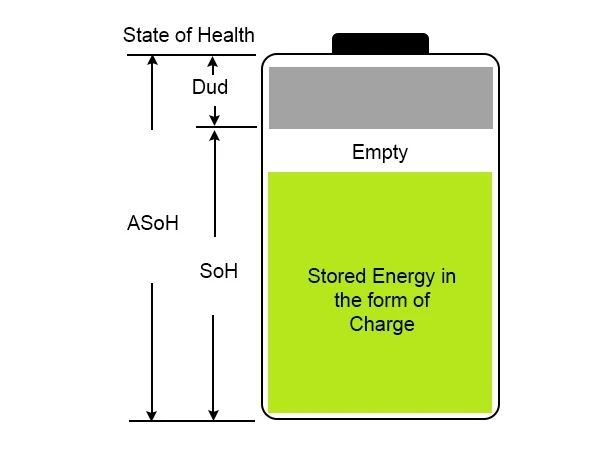
Are SOH values comparable between different vehicles?
Not necessarily.
A fleet containing vehicles from several OEMs can potentially have several different methodologies for calculating SOH. Even within a single manufacturer, battery chemistry, pack generation and software can change over time.
This creates a challenge for fleet operators, insurers, leasing companies and other organisations that need to compare battery condition across large numbers of assets.
A meaningful comparison requires a consistent reference and methodology, rather than simply placing manufacturer-reported percentages next to each other.
This is also where regulation is moving. Euro 7 now includes battery-durability requirements, while UNECE uses SOCE to express the remaining usable battery energy as a percentage of its certified original value. The EU framework also requires minimum battery-energy durability performance for relevant vehicle categories.EUR-Lex
These developments improve standardisation, but they do not turn every existing OEM SOH value into an identical measurement.
Does SOH tell us whether a battery is safe?
This is perhaps the most important distinction.
SOH should form part of a broader battery safety assessment, but meaningful conclusions about battery safety cannot be made from the SOH percentage alone.
A battery at 90% SOH is not automatically safer than a battery at 80%. Likewise, an 80% SOH battery is not automatically unsafe.
Two batteries with the same SOH can have reached that condition through very different histories. One may have experienced moderate temperatures and normal cycling, while another has been exposed to repeated high-power charging, temperature extremes or demanding operating conditions.
SOH also does not necessarily identify an emerging cell abnormality, internal damage, unusual thermal behaviour or deterioration in connectors, wiring, cooling systems and other components surrounding the battery.
This is why EPTTAS distinguishes between State of Health and State of Safety.
SOH tells us something important about degradation and remaining performance. Battery safety requires a wider understanding of the battery's present behaviour, operating history and the condition of the complete system.
Why independent verification matters
As electric fleets grow and age, independently verifying battery condition will become increasingly important.
The objective is not to replace the OEM BMS. It is to provide a consistent additional reference that can help verify the reported SOH, identify calibration differences and make battery condition more comparable across manufacturers and applications.
For EPTTAS, we believe a credible battery assessment needs to answer more than:
“What SOH percentage does the vehicle report?”
It should also answer:
How was that value calculated, is the baseline correct, is it comparable with other batteries, and what does the wider battery behaviour tell us about its State of Safety?
SOH is an important metric.
But until it is understood, verified and placed in the right context, it is still only one part of the battery condition and safety picture.