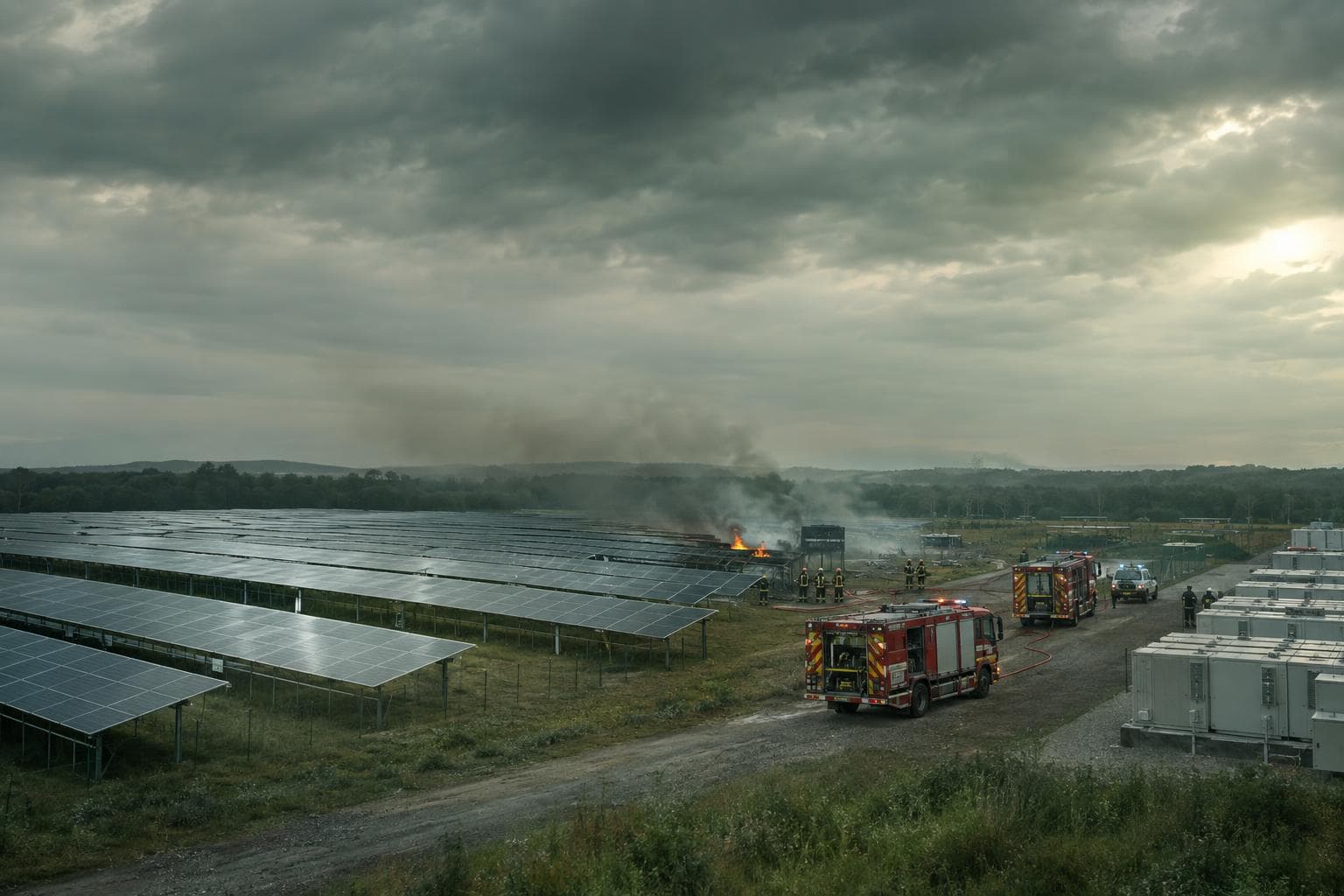
If you’re selling EV batteries in Europe, thermal runaway prevention isn’t just a safety topic anymore. It’s a market-access topic. Under EU 2023/1542, compliance is moving from “show us your documents” to “show us you’re in control”, across sustainability, performance, traceability, and real-world safety. The teams that move fastest are usually the ones that reduce uncertainty early, especially around thermal events. Here’s the founder-to-founder view: compliance delays rarely come from a missing PDF. They come from unanswered questions after something goes wrong. And nothing creates more questions, more scrutiny, and more delay than a battery fire.
The short version
EU Battery Regulation EV batteries are expected to meet tougher requirements on traceability, performance, and sustainability under EU 2023/1542 compliance.
A single thermal event can trigger deeper audits, longer validation cycles, and lost customer confidence.
Treating battery safety as a measurable, auditable process, not a one-off test, helps you move faster.
Why EU 2023/1542 changes the “speed to market” equation
You already know the headline items: carbon footprint declarations, recycled content expectations, the battery passport, performance and durability metrics, and conformity assessment. What’s easy to miss is how these requirements shift the burden of proof. You’re not just proving that a product meets a spec at release. You’re proving that you can track it, understand it, and manage risk through its life.
That’s where battery safety intelligence becomes practical. It’s the difference between:
“We think we’re compliant,” and
“We can show you how we prevent incidents and how we respond when risk signals appear.”
That second posture reduces friction with customers, auditors, and partners because it reduces uncertainty.
The deadlines that will sneak up on EV battery teams
2025: carbon footprint declarations become real work
Carbon footprint declarations force a discipline most teams don’t have by default: consistent data across suppliers, manufacturing, and reporting. That’s not just a sustainability lift. It’s a systems lift. If your safety data lives in one place, your manufacturing data lives in another, and your fleet data lives nowhere useful, you’ll spend your time reconciling, reformatting, and explaining. That slows everything.
2027: the battery passport turns traceability into a daily habit
The battery passport pushes identity and traceability into the foreground. Once that’s in place, questions after an incident get sharper. People will want to know which packs were affected, what changed in firmware, what the usage profile looked like, and whether you saw early warning signs. If you can answer quickly with clean data, you recover faster. If you can’t, you lose weeks.
Performance, durability, and SoH expectations keep tightening
State of Health (SoH) is simply how much usable capacity and performance remain compared to “new.” When SoH estimation is weak, you get surprises. Surprises lead to downtime, warranty exposure, and safety risk. Good SoH visibility is not “nice to have.” It’s a foundation for safer operations and clearer compliance narratives.
Battery fires are the silent market-access killer
Thermal runaway is a chain reaction failure mode. Heat triggers internal breakdown, which creates more heat, which can release gas, increase pressure, and ignite. The business impact is predictable:
operational shutdowns
asset loss
insurance escalation
contract delays
reputational damage
and tougher scrutiny the next time you ask a customer or regulator to trust you
Even if your core technology is solid, the recovery from one event can dominate your roadmap. That’s why battery fire prevention is not just about safety outcomes. It’s about keeping your timeline intact.
The compliance bottleneck nobody budgets for: proving safety at scale
Testing is necessary, but it’s not the whole answer
Abuse tests, thermal propagation tests, and validation campaigns matter. You need them. But fleets and real-world operation introduce variables that labs can’t fully replicate: installation differences, ambient conditions, charge behavior, aging patterns, and firmware drift. So the question becomes: what do you do between tests? This is where teams get stuck. They can’t prove that safety performance in the field matches what was validated in the lab.
The “evidence stack” people expect now
In practice, a credible safety story includes:
how you monitor packs in operation
what you treat as early risk signals
what actions operators take when risk is detected
how those actions are recorded
and how learnings feed back into engineering
That’s not bureaucracy. That’s operational control.
A practical framework to accelerate compliance and reduce fire risk
Here’s a simple approach that helps both manufacturers and operators move faster under EU 2023/1542.
1) Detect early signals, not late-stage alarms
You don’t want to be alerted when the pack is already in crisis. You want to see risk forming. Early-stage anomalies can show up as patterns across temperature behavior, voltage behavior, impedance trends, and charge-discharge profiles. The details vary, but the idea is consistent. If you can detect risk early, you can intervene early. That’s the core of thermal runaway prevention. EPTTAS provides an AI-powered early warning and battery intelligence platform that detects the earliest signs of thermal runaway in lithium-ion batteries, typically up to 60 minutes before ignition. That time window matters because it turns “incident response” into “incident prevention.”
2) Build a single “battery truth layer”
A battery truth layer links identity, configuration, and history in one place. It should include:
pack ID and hardware revision
firmware versions
operating environment and usage profile
SoH and performance signals over time
maintenance actions and anomalies
This helps with safety. It also makes compliance reporting and battery passport readiness much less painful because you stop rebuilding the story from scratch every time.
3) Close the loop between field data and engineering
Field signals should shape your next validation cycle. If you see recurring anomalies under a specific duty cycle, temperature range, or charge pattern, you can:
tune thresholds
update firmware logic
adjust thermal management assumptions
prioritize the right follow-up tests
This reduces rework. It also reduces the chance that your next audit or customer review turns into a long investigation.
4) Make response operational, not ad hoc
Early warning only helps if operators know what to do. That means having a clear playbook for actions like:
isolating the asset
removing it from service
safe storage or transport
escalation to maintenance
documenting the event and outcome
The goal is simple. Protect assets and uptime while you investigate.
5) Make it auditable
If you want speed, you need repeatability. When alerts, actions, and outcomes are recorded consistently, you build a safety record that can be explained to customers, insurers, and auditors. You also build internal confidence that your system works. A clean audit trail is a compliance advantage because it reduces back-and-forth and shortens reviews.
What this looks like in the real world
A practical workflow looks like this:
The system flags an early anomaly that matches known pre-failure patterns.
The operator gets an alert with a clear severity and recommended action.
The asset is isolated and taken out of service.
No fire occurs.
The event is logged, reviewed, and fed into engineering analysis.
Thresholds and playbooks are improved based on what you learned.
This is how battery safety intelligence protects uptime while also strengthening your compliance posture. You’re not just claiming safety. You’re showing a process that prevents escalation.
A simple 30-day start plan for EU operators and manufacturers
If you want momentum, don’t start with a huge rollout. Start with clarity and a pilot.
Week 1: Map your highest-risk points and your current data gaps
Week 2: Establish battery identity and a basic truth layer (IDs, firmware, usage, SoH)
Week 3: Define detection thresholds and response steps for operators
Week 4: Pilot across a subset, then review and expand
This approach builds capability fast without waiting for perfect systems.
Where EPTTAS fits
EPTTAS helps EV fleet owners and operators prevent fires, protect high-value assets and infrastructure, and maintain operational continuity as electrification scales. If you’re working toward EU 2023/1542 compliance, that same capability becomes a practical advantage:
fewer incidents and less disruption
stronger operational control
cleaner traceability and readiness for transparency
better conversations with customers and partners when they ask how you manage safety risk
Next step
If you’re building or operating EV batteries in the EU and you want a faster, lower-friction path through EU 2023/1542, start with the biggest risk to your timeline: thermal events.
Contact us to talk through your fleet or battery program, your current monitoring approach, and what it would take to catch thermal runaway risk early, before it becomes an incident.