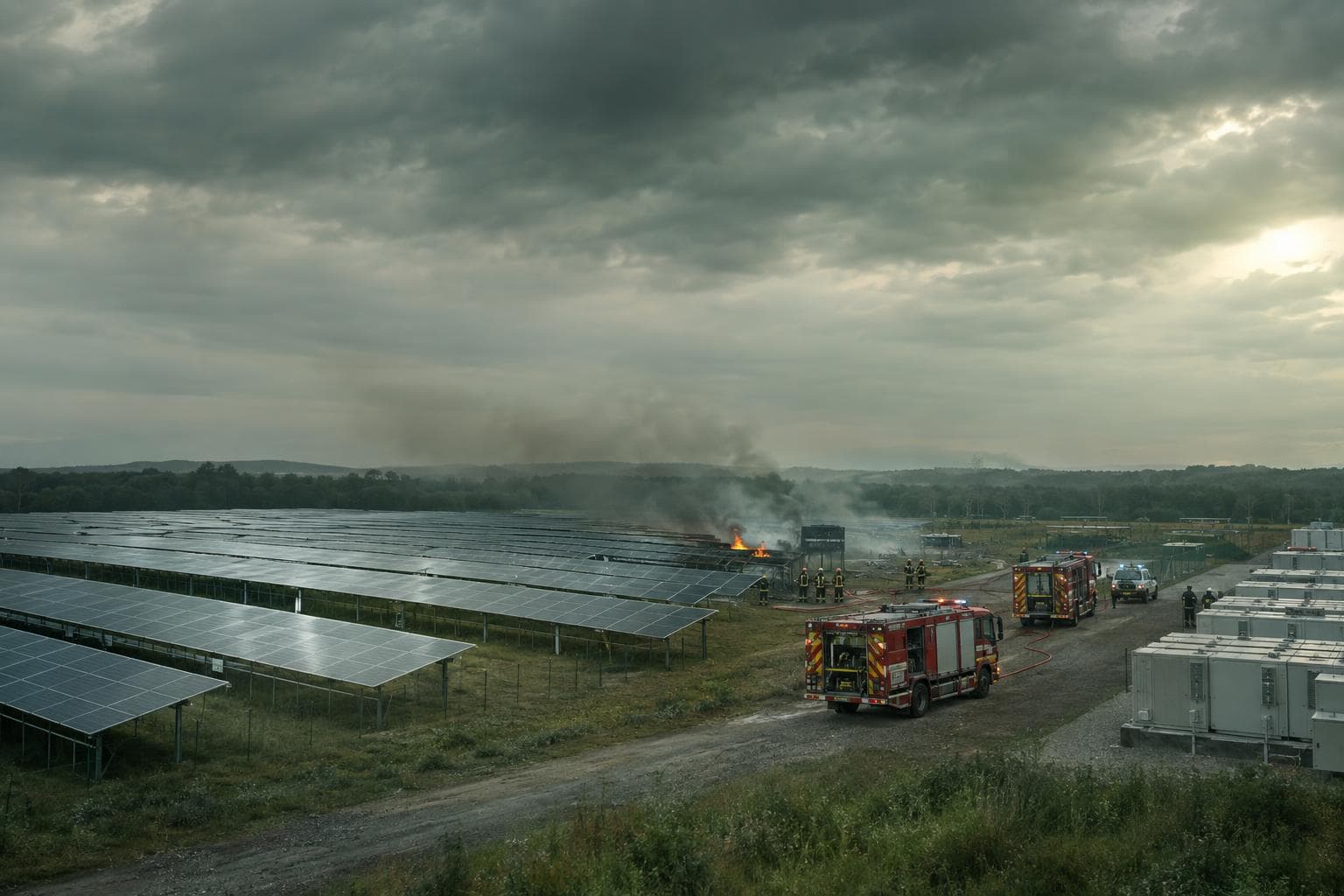
Electrification is no longer a product transition. It is a system transformation. Batteries are no longer isolated components embedded in individual devices. They are now integrated across vehicles, ports, logistics hubs, residential buildings, charging networks, and critical infrastructure. As deployment accelerates, energy density increases. As energy density increases, system exposure expands. What began as a technological shift is now becoming a structural transformation of infrastructure itself.
The conversation is therefore evolving. It is no longer centered on whether batteries function effectively. Their performance and economic viability have already been demonstrated. The emerging question is how battery ecosystems operate safely, predictably, and accountably at scale.
Scale Redefines Risk
The early phase of the battery economy was defined by viability. Performance improved, costs declined, and adoption accelerated.
According to the International Energy Agency (IEA) – Global EV Outlook 2024, global electric vehicle sales exceeded 14 million units in 2023, representing approximately 18% of total car sales worldwide. At the same time, BloombergNEF reports that lithium-ion battery pack prices have declined by more than 85% since 2010, enabling cross-sector feasibility.
Automotive industrialized lithium-ion technology at unprecedented scale. Grid-scale storage expanded rapidly to support frequency regulation and peak shaving. The IEA estimates that global battery storage capacity additions reached record levels in 2023, with grid-scale deployments accounting for the majority of growth.
Residential systems grew alongside distributed solar, while marine applications, micromobility fleets, and data centers integrated battery systems into daily operations.
The viability question has largely been answered. However, scale introduces a different dimension of risk. When batteries shift from isolated assets to concentrated infrastructure, the consequences of failure are no longer contained at the device level. They extend across operational, financial, and regulatory domains. Energy density becomes infrastructure density.
Density Multiplies Exposure
As battery-powered assets cluster in urban environments, logistics corridors, charging hubs, and industrial sites, system interdependence increases. Localized failures may carry broader implications, particularly where assets are physically concentrated or operationally interconnected.
Recent data from the UK Office for Product Safety and Standards (2024) shows a significant increase in fire incidents associated with e-bikes and e-scooters, often linked to charging practices or non-compliant battery systems. This reflects how rapid adoption can outpace safety governance frameworks.
In parallel, stationary energy storage installations are increasingly subject to advanced thermal runaway propagation testing, such as UL 9540A, while organizations including the National Fire Protection Association (NFPA 855) continue refining safety standards for energy storage systems.
Insurance markets are responding. Major global insurers have updated underwriting guidance for lithium-ion energy storage risks, incorporating stricter requirements around separation distances, suppression systems, and documented risk mitigation strategies.
Deployment is accelerating. Safety governance is adapting in parallel. Yet adaptation frequently follows incident data rather than anticipating it.
From Device Monitoring to System Awareness
Battery management systems (BMS) remain essential. They monitor voltage, temperature, and cell balance within individual units. They are foundational to safe operation at the device level.
But modern battery ecosystems generate risk through interactions — between charging behaviors and environmental conditions, between aging patterns and usage variability, between aftermarket modifications and infrastructure constraints.
In dense electrified systems, risk is not solely a device-level phenomenon. It emerges across networks.
Research into lithium-ion failure mechanisms consistently highlights that thermal runaway events are often preceded by detectable anomalies — including abnormal temperature gradients, impedance shifts, or charging irregularities — before propagation occurs. However, such signals may remain siloed if not analyzed within broader operational context.
This reality is contributing to the gradual emergence of an ecosystem-level safety intelligence layer. Rather than focusing exclusively on individual battery parameters, such frameworks integrate operational data, health analytics, anomaly indicators, and contextual information to provide broader visibility into system behavior.
The shift is structural. The objective is not only to detect failure, but to identify risk signals earlier in the curve.
Lifecycle Accountability Is Increasing
As deployment volumes rise, lifecycle management becomes economically and regulatorily material.
The European Union’s Battery Regulation (Regulation (EU) 2023/1542) introduces digital battery passports and lifecycle accountability requirements beginning in 2027. These requirements include carbon footprint disclosure, recycled content targets, and performance transparency across the battery lifecycle.
Second-life applications for EV batteries are also expanding. According to the International Renewable Energy Agency (IRENA) and industry assessments, repurposed EV batteries are expected to contribute meaningfully to stationary storage markets in the coming decade.
Transparency is therefore embedded in both environmental and economic governance.
Operational visibility influences compliance, warranty exposure, asset valuation, and insurability. Safety and lifecycle intelligence converge within this accountability framework.
Capital and Insurance Are Redefining Expectations
Infrastructure investors and insurers operate on measurable exposure. Opaque risk increases uncertainty. Uncertainty increases cost of capital.
Global reinsurers, including firms such as Munich Re and Swiss Re, have published analyses emphasizing the importance of risk transparency and fire mitigation strategies in battery energy storage systems. Underwriting models are evolving toward more granular assessment of battery condition, operating environment, and mitigation mechanisms.
Continuous, data-backed safety visibility aligns operational resilience with financial sustainability.
In high-density electrified ecosystems, safety intelligence is increasingly linked to insurability.
Scaling Changes the Conversation
Electrification now extends across urban mobility fleets, industrial storage installations, residential energy systems, port infrastructure, logistics corridors, and grid-scale assets. Global battery storage capacity is projected by the IEA to expand several-fold by 2030 under stated policy scenarios. System interdependence is rising. Regulatory scrutiny is increasing. Public visibility is expanding. The central question has shifted. It is no longer whether electrification works. It demonstrably does. The emerging challenge is how to manage energy concentration, lifecycle accountability, and systemic resilience as electrification scales.
Institutions such as the International Energy Agency, the European Commission, and national safety authorities increasingly emphasize that electrification must be accompanied by digital monitoring frameworks and governance mechanisms. Infrastructure-scale energy systems require infrastructure-scale intelligence.