As electrification accelerates across transport sectors, understanding the technical architecture of lithium-ion batteries is no longer optional — it is fundamental to risk assessment, incident response, and operational safety.
At EPTTAS, we emphasise that effective decision-making in battery fire scenarios starts with a clear understanding of how these systems are built — and how they fail.
Battery Architecture: Cell → Module → Pack
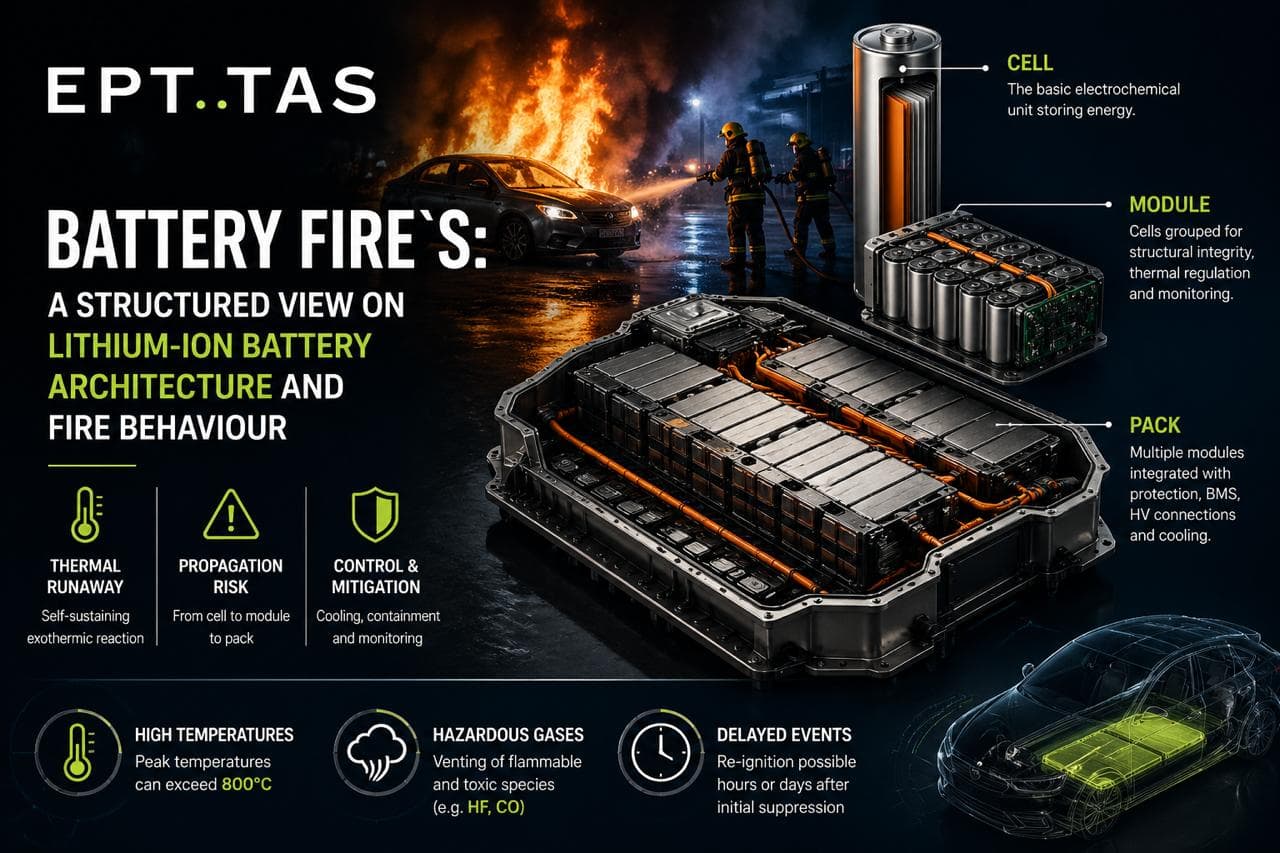
Lithium-ion battery systems in electric vehicles are engineered in hierarchical layers, each with distinct safety and performance functions:
Cell
The fundamental electrochemical unit. Typically based on lithium-ion chemistries such as NMC (Nickel Manganese Cobalt) or LFP (Lithium Iron Phosphate), each cell stores and releases energy through controlled ion movement between electrodes.
Module
Cells are grouped into modules to improve:
Structural integrity
Thermal regulation
Electrical monitoring
Modules often include cooling channels and sensing systems designed to manage localised temperature variations.
Pack
The full battery system consists of multiple modules integrated into a protective enclosure. The pack includes:
Mechanical protection (crash structures)
High-voltage connections
Integrated safety systems
This layered design improves performance and redundancy — but also introduces pathways for failure propagation.

Battery Management System (BMS): Control and Limitations
The Battery Management System (BMS) is designed to maintain safe operation by monitoring:
Voltage and current
State of charge (SoC)
Temperature distribution
It can isolate faults, limit charging, and trigger protective shutdowns. However, BMS effectiveness is constrained in scenarios involving:
Mechanical damage (e.g. post-collision deformation)
Internal short circuits
Rapid thermal escalation
Once a failure progresses beyond control thresholds, the system may no longer prevent escalation.

Thermal Runaway and Propagation Dynamics
A key risk in lithium-ion systems is thermal runaway, a self-sustaining exothermic reaction triggered by overheating or internal failure.
According to National Fire Protection Association and National Highway Traffic Safety Administration, thermal runaway can:
Initiate in a single cell due to mechanical, electrical, or thermal abuse
Propagate to adjacent cells within the same module
Escalate across modules depending on pack design and spacing
Experimental work, including studies published in the Journal of Power Sources and by UL Solutions, demonstrates that cell-to-cell propagation remains one of the most critical hazards, particularly in high-energy-density packs.
Key findings from the literature include:
Peak temperatures during thermal runaway can exceed 800°C
Gas venting includes flammable and toxic species (e.g. HF, CO)
Re-ignition is possible hours or days after initial suppression

Implications for Firefighting and Incident Management
From an EPTTAS perspective, the architecture directly explains operational challenges observed in real incidents:
1. Cooling Limitations
Water application primarily cools external surfaces. Internal cell temperatures may remain elevated, requiring prolonged cooling strategies.
2. Delayed and Secondary Events
Damage at cell level can lead to latent failures, reinforcing the need for monitoring and controlled storage post-incident.
3. Complex Suppression Dynamics
Unlike conventional vehicle fires, extinguishment does not equate to risk elimination. The objective shifts from “extinguish” to “control, cool, and contain.”
Guidance from International Association of Fire Chiefs and NFPA increasingly reflects this shift in operational doctrine.
Research and Data Points
A selection of relevant findings supporting current understanding:
National Renewable Energy Laboratory highlights that battery pack design strongly influences propagation resistance, with spacing and thermal barriers being critical factors.
Studies in Fire Technology indicate that water remains the most effective cooling agent, but requires significantly higher volumes compared to internal combustion vehicle fires.
Research coordinated by European Commission Joint Research Centre identifies knowledge gaps in post-incident handling and stranded energy risks.
EPTTAS Perspective
The increasing complexity of battery systems requires a shift in how incidents are approached:
Technical understanding must be included in business and operational decisions
Risk analysis must include the known limitations of existing safety solutions
The whole ecosystem around a battery operation must be included to monitor battery fire risk